Why AI needs Crypto
Stepan Gershuni, cyber.Fund.
Automatically translated by AI
Talk Topics
- What is the difference between centralized A(G)I and decentralized AI, and how does it affect all of us?
- What methods and mechanisms can ensure the safe use of technologies?
- How can decentralization help us avoid the influence of large corporations and governments?
Towards the Cybereconomy
Cybereconomy is the idea that automation, optimization, and distributed networks of software systems will lead to a more efficient economy and civilization overall, as well as solving many problems. The author wants to demonstrate this using two major trends currently influencing how society and the economy are organized.
On one hand, there’s the evolution of the Internet. The Web 1.0 era emerged in the late 1980s–early 1990s as a publishing platform where anyone could create their own website. Then came Web 2.0 (Facebook, Twitter, Instagram), where anyone could publish their own content, not just the site owner. Finally, Web 3.0 gave people the ability not just to publish, but to own digital assets — including money, domain names, NFTs, game items, and staked tokens.
In parallel, software development has evolved as a problem-solving method. Historically, 40–60 years ago, software meant writing deterministic code to perform a task. With the rise of deep neural networks, the approach shifted to training a network to solve the task, instead of explicitly coding the algorithms.
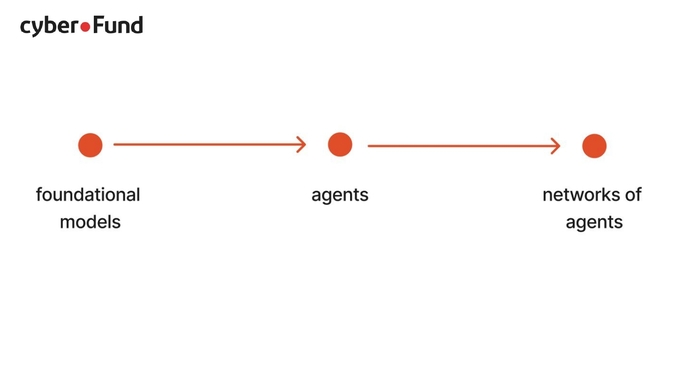
The next logical step is autonomous agents — systems or applications that use neural networks to make decisions, perform logical reasoning, and even create additional neural networks to solve user tasks.
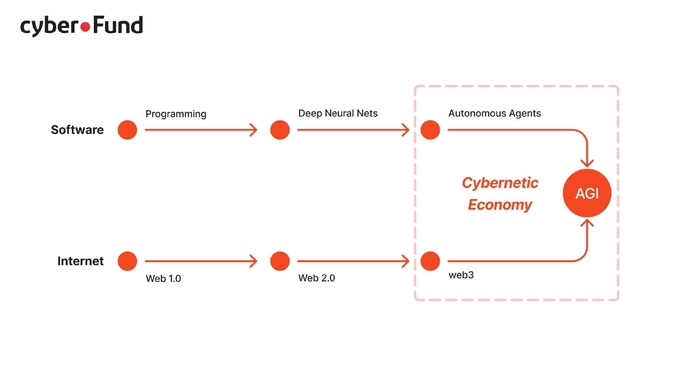
The simple version of this idea is: the Internet progressed from reading → reading & writing → reading, writing & owning content.
In software: people first wrote code, then trained self-optimizing neural networks, and ultimately we get to a point where the user doesn’t need to write code or train networks — just speak or type the desired outcome, and an autonomous agent or network of agents does the rest.
This could make natural language programming (English, Arabic, Chinese, Russian, etc.) the standard for many simple tasks.
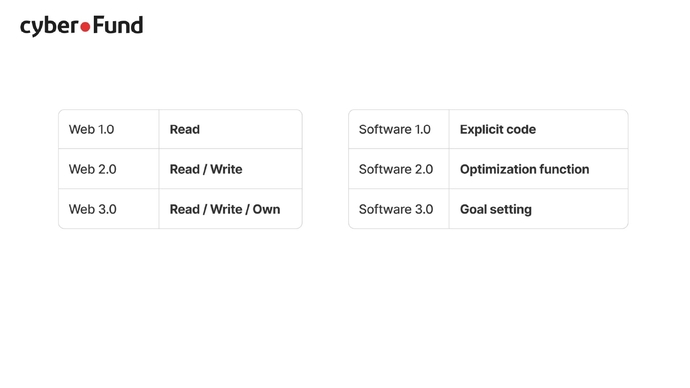
In AI, we’re moving from building foundational models — which are getting smarter (LLMs, diffusion models, video transformers, image generation models, etc.) — toward agents using these models. Ultimately, this leads to AGI: systems capable of performing a significant share of economically valuable tasks that humans do today. Some are purely intellectual; others require real-world interaction — meaning AGI will eventually need robots or smart devices. But right now, even if agents can chat, they can’t yet perform most key economic functions.
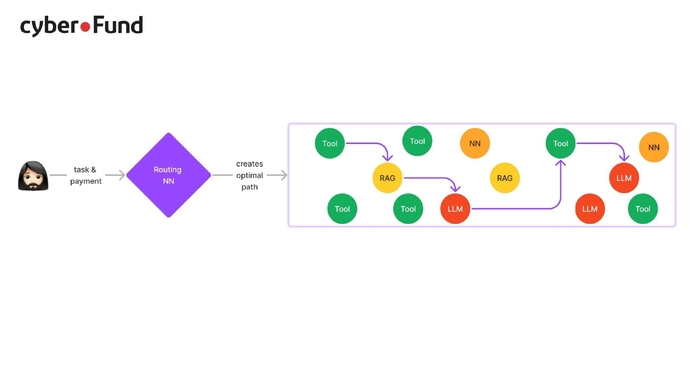
A decentralized AGI world: A person has a task — business, personal (trip planning), or social (environmental improvement). This is sent into a network of tools: neural nets, agents, LLMs, robots, devices. Solving such a task often requires coordination across multiple agents — one may produce text, another hire contractors, another draft laws. LLMs today can handle simple Q&A or image generation but not fully replace human roles. We’re moving toward agents that can plan, coordinate, and execute complex multi-step tasks.
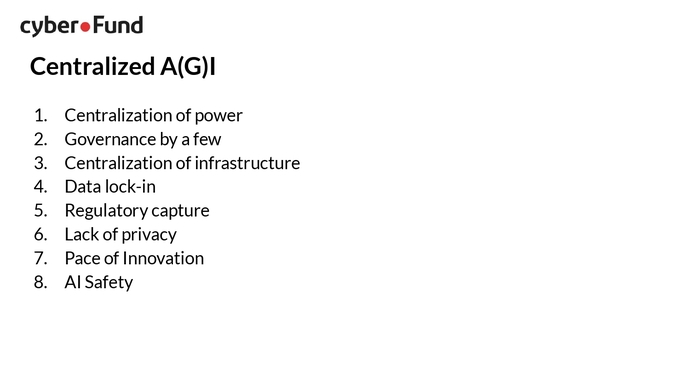
Centralized A(G)I
Centralization
This is one of humanity’s biggest short-term challenges (5–10 years). AI can help solve most big problems — drug discovery, resource allocation, education, climate — but who controls it matters. If AI with human/superhuman abilities is run by just 2–3 companies or states, the risks are huge.
History shows absolute power in few hands leads to inequality and abuse. Economically, monopolies slow innovation and distort pricing. A monopoly on fuel changes prices; a monopoly on AI means controlling human decision-making. AI could become an “intellectual implant,” influencing decisions in health, education, finance, business — but its behavior depends on its trainers’ biases.
If the infrastructure is centralized, access can be cut off at any time.
Data Control
The more data you give AI, the better it understands you. But if stored/processed by Google, OpenAI, etc., you risk losing control — best case, privacy loss; worst case, data used against you.
Regulatory Capture
Big firms with resources can get licenses and approvals to run advanced AI; open-source communities and startups may be blocked by costs and regulation.
Speed of Innovation
Open source accelerates innovation via many parallel experiments, but corporations have resources, processes, and monetization strategies to turn ideas into real products.
AI Safety
AI safety risks aren’t just sci-fi takeover scenarios — they include real threats like financial fraud.
Decentralized AI
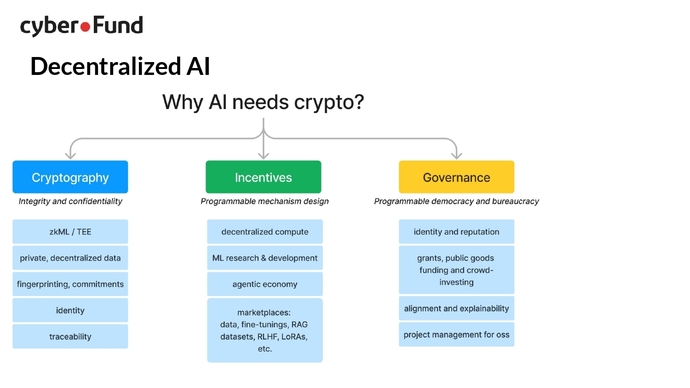
Crypto can help in three key areas:
- Cryptography — ensures data integrity/privacy; math can’t be outlawed like policy can.
- Incentives — decentralized networks reward participants (e.g., Ethereum validators).
- Governance — tools like digital ID, DAOs, public goods funding.
Design of Decentralized Networks
Bitcoin example: users pay fees for secure value transfer; network rewards miners.
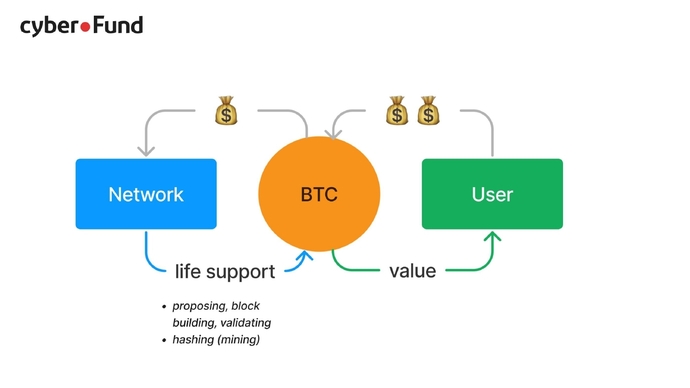
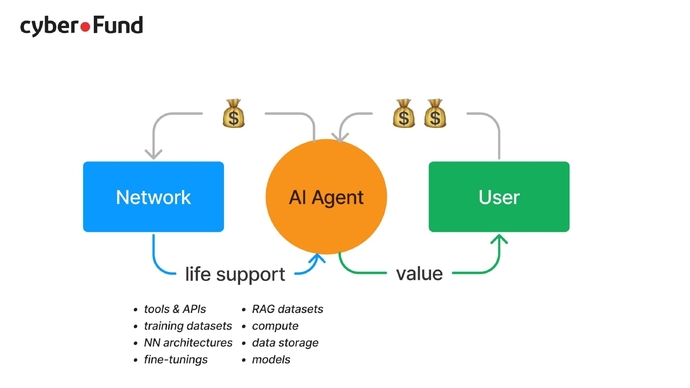
Design of AI Agent
An AI Agent books tickets, diagnoses, trains, builds sites. In centralized form, you pay OpenAI; in decentralized, the agent runs on a substrate with compute, models, datasets, storage, tools, and can hire other agents.
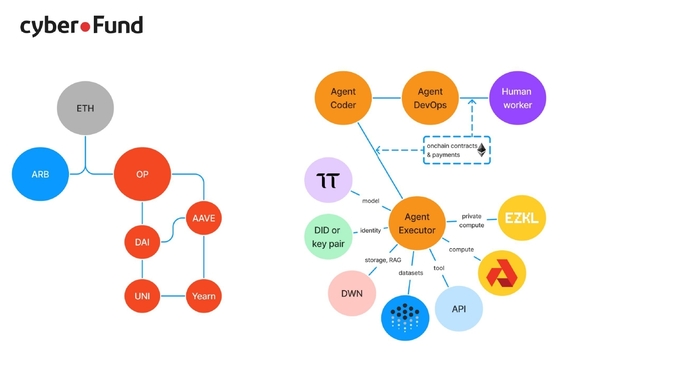
ETH and AI Architectural Models
Similar architecture: Ethereum → DApps (rollups, Aave, Uniswap) → strategies (Yearn). AI: agents communicate (on/off-chain), use infra (e.g., Akash) to pay for compute/models, self-improve, reward contributors with tokens — forming a cybereconomy.
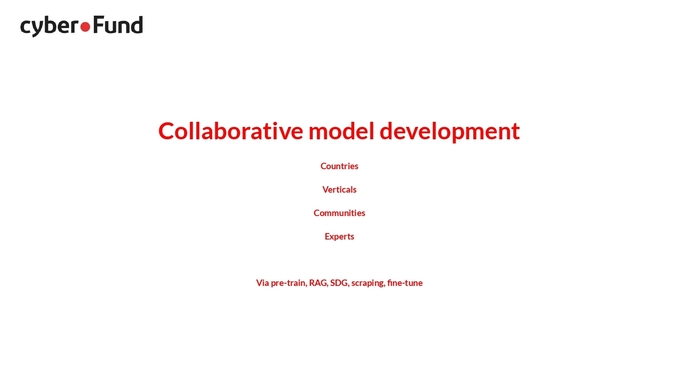
Collaborative Model Development
Trend toward smaller, specialized models (medicine, sports car repair) vs. general-purpose LLMs.
Private AI
Privacy tech for decentralized AI:
- Trusted Execution Environment (Intel SGX, NVIDIA Confidential Computing) — encrypts data in enclaves.
- Zero Knowledge — guarantees execution correctness, not privacy.
- Fully Homomorphic Encryption — processes encrypted data without decryption.

Incentives Design
- Shared ownership via tokens.
- Staking/slashing for governance/security.
- Game theory models for decision optimization.
- DAO-based open alternative to OpenAI.
Marketplaces
Four layers:
- Data — collected, scraped, or synthetically generated.
- Compute — decentralized model training/inference.
- Models — ready-to-run in decentralized networks.
- Tools — non-AI agent tools (e.g., Google Sheets).
Routing, Orchestration, Communication
The core challenge: connecting thousands of models and trillions of agents optimally — leading to AGI as a network of specialized agents.
Payments
Agents need on-chain accounts to pay/receive funds (BTC, ETH, USDT) and to pay other agents or humans for specialized tasks.
Identify
Agents need reputations to distinguish reliable ones and fight deepfakes.
Governance
Coordinating people/resources to make all aspects function — if routing is the AGI “final boss,” governance is the “final boss” for human coordination.
Conclusion
If we delay, centralized proprietary AI will be in the hands of a few — effectively outsourcing humanity’s thinking and actions to them.