Your Privacy-First AI Memory
Why personal AI memory must be local, private, and self-hosted.
The problem: memory without sovereignty
The talk starts from a shared concern about the near future of human–AI interaction. Always-on assistants, smart glasses, and ambient recording devices are rapidly turning people into cyborgs — but with memory and perception owned by large corporations.
The speakers describe this as a fundamental asymmetry: the technology is attractive, but the loss of control over personal memory is not.
Market reality: no private AI memory exists
After surveying existing solutions, the team found that all AI memory products rely on centralized infrastructure. Conversations, screenshots, voice, and context are sent to external servers by default.
This creates a structural conflict of interest. The system optimizing memory is not aligned with the user, but with the platform monetizing that memory.
Mycelia: local-first AI memory
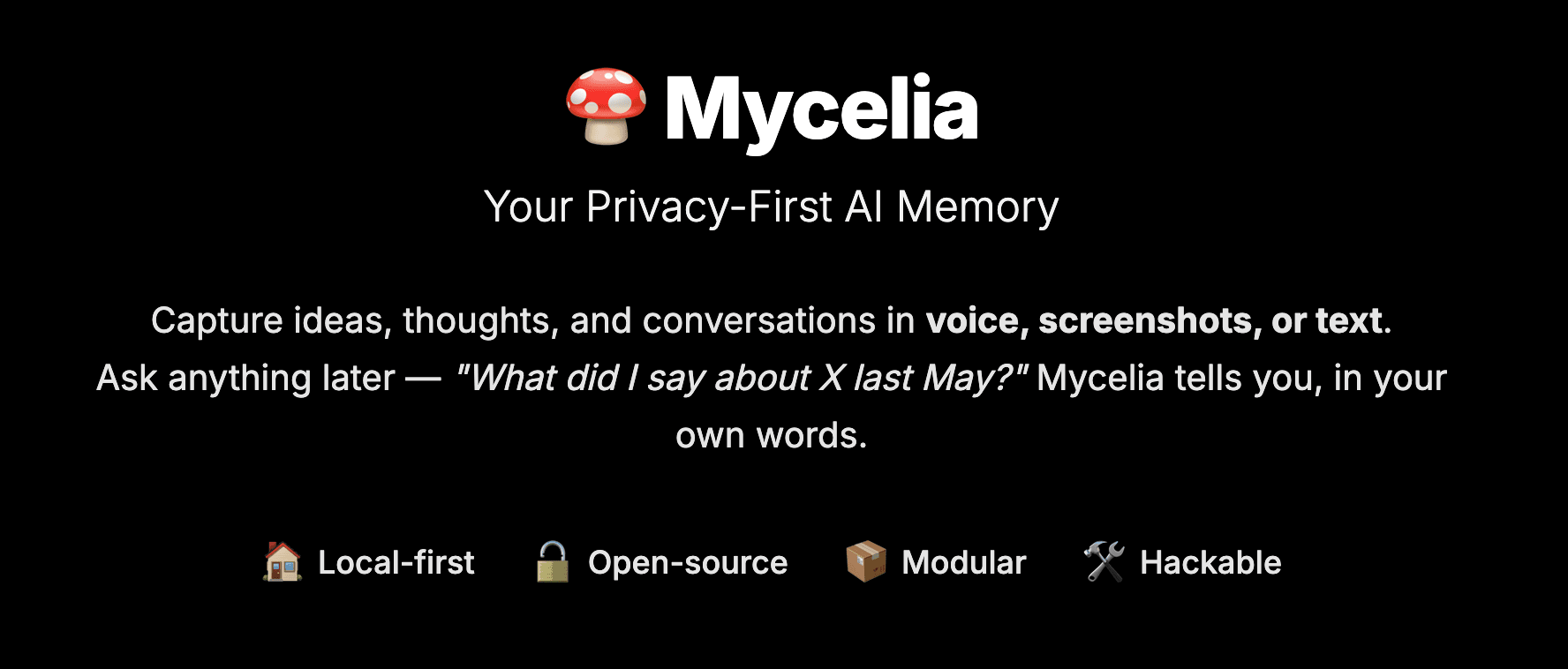
Mycelia is built as a privacy-first AI memory system. It captures ideas, conversations, screenshots, and voice locally, and allows users to query their past later — in their own words.
The core principle is strict: your data never leaves your infrastructure.
The system is fully open source and designed to run on personal hardware, from a home server to any self-hosted environment.
Memory as the real AI bottleneck
Tigor Bakutin argue that the key limitation of current assistants is not interaction quality, but long-term memory. Humans forget context quickly, while AI becomes powerful only when it can recall history over months and years.
A personal AI memory effectively becomes an external brain — but only if it serves the user exclusively.
Conversations as first-class data
Photos and notes are routinely archived, but conversations — often the most valuable source of context — are usually lost. Mycelia treats conversations as first-class data, allowing users to store them locally without cloud dependency.
This enables deep recall of personal history, reasoning patterns, and long-term context.
Centralized memory as a systemic risk
Examples like Google Timeline show how powerful behavioral reconstruction can be. The issue is not capability, but ownership. Centralized memory systems create incentives misaligned with individual autonomy.
Beyond personal privacy, the speakers emphasize a systemic argument: decentralizing memory storage increases societal resilience compared to concentrating it in large data centers.
Technical approach
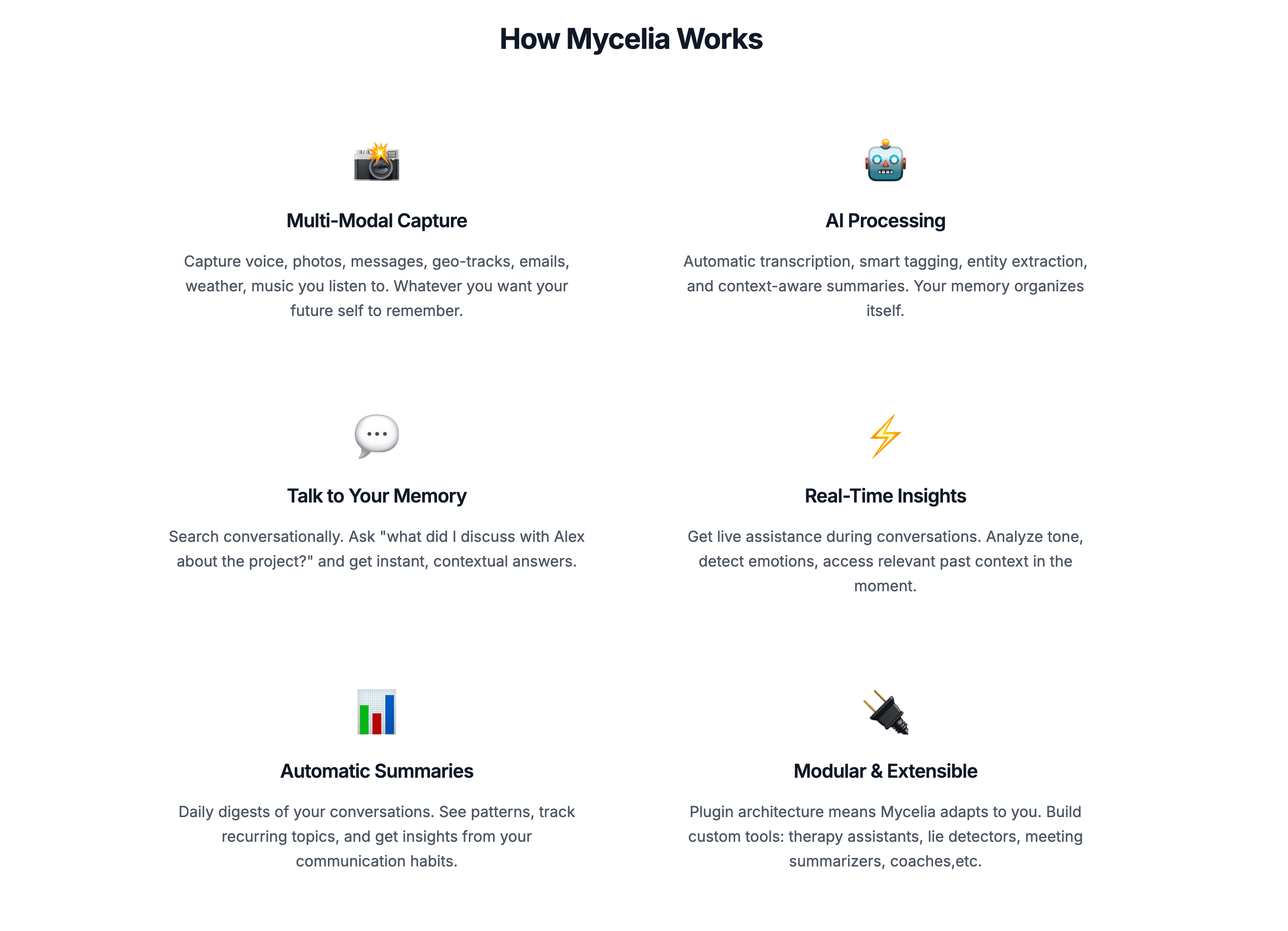
Mycelia can be deployed using standard tooling and runs fully self-hosted. It does not require specialized hardware and supports flexible input sources such as voice notes, text, and screenshots.
Users can run it locally or on infrastructure they fully control.